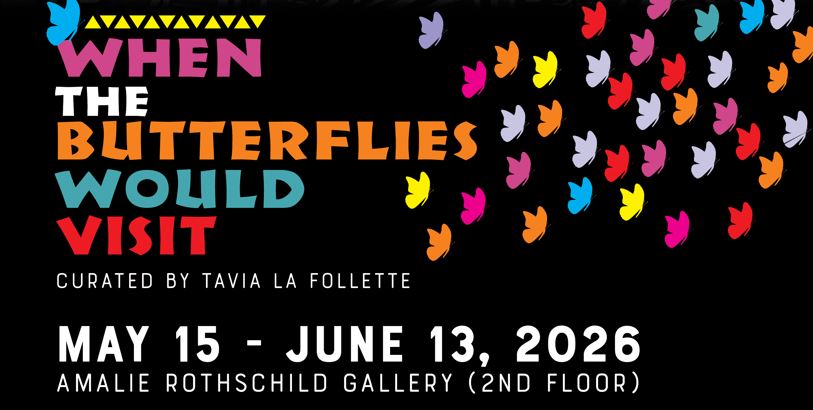
When The Butterflies Would Visit Performance: May 16, 7:30-8:30PM
Featuring Panama Jam by JAM
Come experience two performances that ask a simple but powerful question: how do we keep knowledge alive? Panama Jam draws from stories and songs shared by Guna community members in Panama, showing how what we know lives in our bodies, our voices, and the people around us. When the Butterflies Would Visit takes that same idea into language and grief, with a student ensemble from Towson University performing scenes from a play that inspired the exhibition’s title.
About the Performances:
When The Butterflies Would Visit
“When the butterflies would visit” is a line from the play, THE INVENTION OF SEEDS, by Analisa Dias and the inspiration for the title. These are the words of a South African goldminer, grieving with SOIL and The Center of the Earth, other characters in the play. The performance is devised from a few sections of the play and through the Ensemble class, taught/directed by La Follette, at Towson University’s Department of Theatre Arts.
The student Ensemble include Hadassah Alabi, Katie Bartles, Caden Choi, Dorian Edwards, Sierra Johnson, Roman Nowak, Ray Ortiz, Kayla Rosario Thomas, Kaiya Scales, Michael Simpson, Billy Snyder, Hua Su, Nico Thompson & Cyan Williams.
Stage Manager, Jasmine Artis & Assistant Director, Jada Lane with Light Design by Eva Mendoza and Live Sound Design by Conner Rock & MacKenzie Crowley. Cinematography by Casey Gessert & Ayden Kelly.
Panama Jam
Panama Jam comes out of time spent in Armila, Panama, where performer and researcher JAM was learning from Guna community members about conservation practices, storytelling, and what it means to sustain knowledge across generations—especially in relation to leatherback sea turtles. The work doesn’t try to present that knowledge as complete or settled. Instead, it moves through fragments—songs, recordings, live narration, and moments of exchange that build as the performance unfolds. Panama Jam can be thought of as a kind of live broadcast: something structured but always shifting depending on who’s in the room.
Audience members are part of that. Not in a forced way, but in the sense that their presence, attention, and responses shape the rhythm of what happens. For JAM, this is about staying with knowledge as something living—something carried through bodies, voices, and shared time, rather than something fixed in place.
From Trash to Puppets: Street Puppet Building Workshop | May 30–31
Join Tavia La Follette for a two-day workshop where you will learn how to turn reclaimed materials into powerful imagery that moves your message through the community. Participants will explore a brief history of street puppetry and gain hands-on experience in up-cycling and scavenging free materials to create large-scale puppets and expressive masks for street performance.
RSVP required (limited space) | RSVP & Info